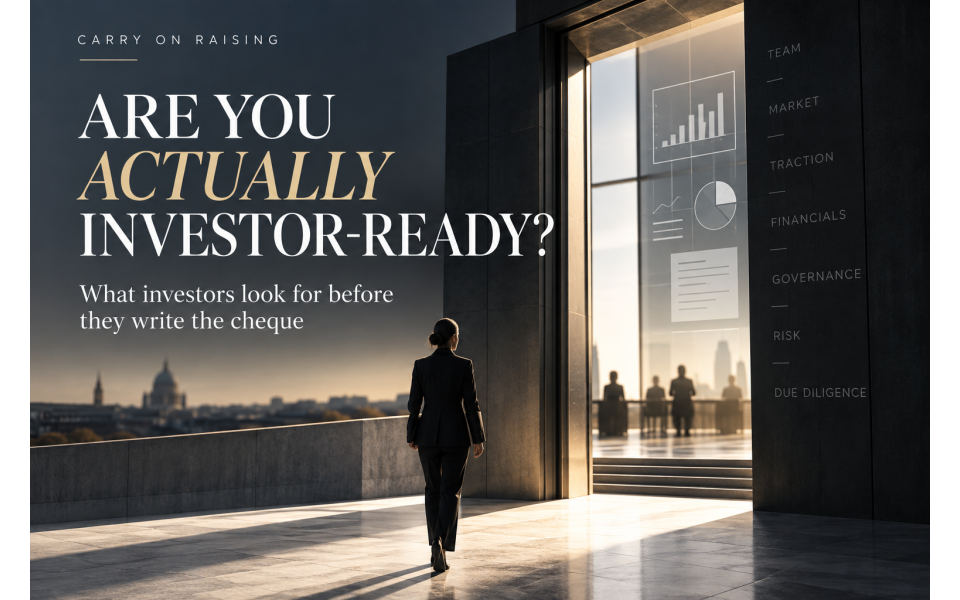
Are You Actually Investor-Ready?
September 2026
What 10 years advising family offices and private investors has taught me about raising capital
I wanted to share some direct advice and help based on having spent the best part of the last ten years advising family offices, alongside more than twenty years working with entrepreneurs, investors, funds, and companies raising capital. During that time, I've been fortunate enough to see fundraising from almost every angle: as a founder myself, as an adviser preparing companies for investment, as an intermediary sitting between investors and opportunities, and alongside family offices deciding where they actually want to deploy their money.
One thing I've learned is that there is often a surprisingly large gap between having a good business and having an investable proposition.
The two are not necessarily the same thing.
I regularly meet founders running perfectly credible businesses who assume the next logical step is to raise capital. They build a deck, produce a financial model, put together a target list of investors, and start sending emails. Three or six months later, they have had plenty of conversations but very little progress.
The conclusion is often that investors aren't investing. Or that their business proposition is not good.
Usually, that isn't quite true.
Capital is certainly more selective than it was during the era of cheap money, but investors are still deploying enormous amounts of it. What has changed is the threshold. A reasonable idea and an optimistic financial model are no longer enough. Investors have more opportunities competing for their attention, and consequently founders need to demonstrate much more clearly why their company deserves to be one of them.
From the family office side of the table, this becomes particularly obvious.
When you're reviewing opportunities regularly, you start to notice that the strongest propositions tend to answer the same questions extremely well. On the first founder-investor call they will be asked 10-15 questions and hit it one out of the park, concise and clearly communicated. They know precisely what problem they solve, who will pay them to solve it, why their team has a credible chance of winning, what evidence they have that the market actually wants what they're selling, and exactly what new capital will enable them to achieve.
That observation eventually became the basis of the 50-question Investor Readiness Exercise we use at Fundsurfer before putting founders in front of serious investors. The premise is deliberately simple: investors don't fund ideas; they fund clarity, credibility, and momentum.
We offer it to all of our clients for free when they sign up but wanted to make it available to anyone interested.
Before you download it, however, I think it's worth explaining why some of those questions matter.
Your pitch isn't really about your pitch deck
This is probably the first misconception worth getting rid of.
A pitch deck is a communication tool. It is not the investment proposition itself.
I've seen beautiful decks attached to businesses I wouldn't invest £1 into, and fairly ordinary decks attached to founders and companies where you immediately want to know more.
What matters is what sits underneath the presentation.
The first section of our readiness exercise therefore doesn't ask about your slide design, logo, or whether you've managed to squeeze your entire business model onto a single graphic. It asks seven extremely basic questions, beginning with: “In one sentence, what does your company actually do, without buzzwords?” It then asks what problem you're solving, why that problem matters now, who your customer actually is, how large the opportunity could realistically become, and why you're the company that can win it.
Those questions sound easy until you try answering them properly.
I've sat through pitches where ten minutes into the meeting I'm still not entirely sure what the company does. That's a problem. If somebody who spends their working life looking at investments cannot understand the proposition quickly, expecting an investment committee or family principal to spend another hour decoding it is unrealistic.
There is a slightly tongue-in-cheek rule in the document that sums this up quite well: if your mum can't understand this section, investors probably won't either. The thing is - that is so true!
The more complicated the business, the more important simplicity becomes.
Investors have become very good at spotting vanity numbers
Market sizing is a perfect example.
A lot of the decks I receive contain a slide telling me that the company operates in a market worth tens or hundreds of billions of pounds. Occasionally we make it into the trillions.
The problem is that the size of the global market tells me remarkably little about whether your company can build a significant business within it.
If you're developing software for independent dental practices in Britain, telling me the global healthcare industry is worth several trillion dollars doesn't help me understand the investment opportunity. I want to know how many potential customers you can genuinely sell to, what they spend, how difficult they are to acquire, what percentage you could realistically capture, and what evidence supports those assumptions.
That's why the market section of the exercise asks founders to calculate their true addressable market step by step, explain what percentage they genuinely believe they can capture, identify the trends helping and hurting them, and consider what happens if the market grows more slowly than expected.
I've seen too many decks quoting trillion-dollar markets while the company is fighting for its first £50,000 customer.
Precision beats ambition.
At an early stage, I'm often investing in you
This is something founders sometimes underestimate, particularly when talking to family offices.
Of course we analyse the company. We look at the market, numbers, competition, structure, and potential return. But we're also making a judgement about the people sitting across the table. The team and founders are incredibly important when it comes to writing a cheque.
Businesses rarely develop exactly according to the original pitch deck. Markets change. Products change. Competitors emerge. Customers behave differently from the model. Capital takes longer to raise than expected. Something somewhere will go wrong. No set of financial projections has ever panned out exactly as presented.
The question becomes: do I trust this team to deal with it? When the shit hits the fan how will they react? (It’s 100% when, not if)
I want to understand why you started the company and what particular insight or advantage you bring to it. But I also want to know where you're weak.
That last point is important.
A founder who can tell me, without embarrassment or deflection, that they are excellent at product but poor at sales — and then explain who they've brought in to solve that weakness — is displaying self-awareness. A founder who appears to believe they have no weaknesses at all is generally telling me something quite different.
Our exercise deliberately asks founders what their unfair advantage is, where they're personally weak, which roles are missing from the business, and why the existing team will still find a way through if things become difficult.
I've backed average ideas with exceptional teams and watched them win.
Products can pivot. Good teams survive the pivot.
Traction changes the conversation
There is a moment in the development of a company when the fundraising conversation begins to change from “here is what we think will happen” to “here is what is already happening.”
That transition is incredibly important.
Every piece of genuine evidence removes a little uncertainty from the investment decision. A paying customer is for sure more valuable than a market survey. Ten returning customers are more interesting than ten expressions of interest. Revenue is generally more persuasive than a pipeline, and repeatable revenue is considerably more persuasive than one lucky contract.
This doesn't mean an early-stage company needs millions in sales before approaching investors. Different stages require different evidence. But there should be something that demonstrates the world is behaving broadly as your investment thesis says it should.
Our exercise asks what traction proves demand today, which metric matters most, how repeatable that traction is, and what meaningful progress should look like six months from now. Interestingly, it also asks what failed experiment taught the company the most.
I like that question because good investors aren't expecting founders to have been right about everything.
What matters is how quickly you learn when you're wrong. Being transparent about areas you know you need to improve on shows strength not weakness.
Know the commercial engine, not just the revenue forecast
One of the quickest ways for an investor conversation to become uncomfortable is when we move from the headline forecast into the assumptions underneath it.
A graph showing revenue growing from £500,000 to £50 million over five years is easy to create. A big hockey stick shape showing supercharged growth.
Explaining exactly how that happens is harder.
You have to be able to answer questions like: How do customers find you? What does it cost to acquire one? How much is that customer realistically worth? How long does it take to move from first contact to cash arriving in the bank? What happens to those numbers as you scale?
These are among the questions in the commercial section of our exercise because they expose whether the financial model is connected to what is actually happening inside the business.
If you tell me you're going to increase sales tenfold, I'm naturally going to ask what needs to increase tenfold to make that happen. Salespeople? Marketing spend? Manufacturing capacity? Working capital? Distribution?
Growth consumes resources.
The better founders understand exactly which resources it consumes.
Please tell investors what could go wrong
One of the stranger rituals in fundraising is pretending there isn't any risk.
The investor knows there is risk.
You know there is risk.
Yet occasionally everybody sits in the room pretending otherwise.
I much prefer founders who can explain what keeps them awake at 3am. It’s one of the main questions I like to ask - “what keeps you up at night when thinking about your business?”
Maybe it's customer concentration. Perhaps it's regulation, working capital, a dependency on one key supplier, recruitment, technology risk, or the possibility that the next funding round takes twice as long as expected.
Our readiness exercise explicitly asks for the single biggest risk to the business and what keeps the founder awake at night.
That isn't designed to catch people out.
It's designed to establish whether management understands its own downside.
Investors know every plan has risks. What makes us nervous is when founders pretend otherwise.
The most important question: what does my money actually do?
Eventually, every fundraising conversation reaches the money.
How much are you raising?
And why exactly that amount?
I find the second question considerably more interesting than the first.
There should be a direct relationship between the amount of capital being raised and the milestones that capital unlocks. If you're raising £3 million, I want to understand what £3 million gets us that £1 million doesn't. Being able to easily explain use of funds is critical.
Does it complete the product? Reach profitability? Open two markets? Build the team? Deliver the first ten projects? Take revenue from £2 million to £10 million? Secure regulatory approval?
Capital should move the company from one identifiable point to another.
That's why the final section of our exercise contains only three questions: How much are you raising and why? What milestones will the round unlock? And if everything goes well, what does a credible exit actually look like?
The rule underneath those questions might be the most important in the entire document:
Capital should accelerate progress, not buy time.
So, are you actually investor-ready?
This is the question I think more founders should ask before beginning a raise.
Not: Can we create a deck?
Not: Do we know some investors?
Not even: Do we need capital?
Are we genuinely ready for somebody intelligent, sceptical, and experienced to interrogate this business? You only get one chance to show you know your stuff, if you slip, it’s over. Harsh but true.
The Fundsurfer exercise contains 50 questions and scores each answer from zero to three. A zero means the answer is unclear or doesn't exist; one means it's largely theoretical; two means it is credible and supported by logic or evidence; and three means it's specific, evidence-backed, and capable of standing up to investor scrutiny.
That gives a maximum score of 150. We've broadly classified 120–150 as investor-ready, 90–119 as nearly ready, 60–89 as early-stage readiness, and below 60 as a sign that raising serious capital is probably premature. More useful than the headline number, however, is looking at the individual sections. A weak score immediately tells you where the holes in the proposition are.
And that's why I think we should give the exercise away.
I'd much rather a founder discover those weaknesses sitting around a table with their co-founders than sitting across the table from an investor they've spent six months trying to meet.
Answer the questions honestly. Don't write what you think an investor wants to hear. Write what is actually true. Then look particularly hard at anything you scored zero or one.
Those answers become your worklist.
Because after ten years working alongside family offices, and considerably longer helping entrepreneurs raise money, the lesson I keep coming back to is surprisingly simple.
Good companies don't automatically raise capital. Prepared companies have a much better chance.
Do the work before the meeting. Run roleplays with your team until you feel comfortable.
Know your market. Know your numbers. Know your weaknesses. Understand your risks. Be able to demonstrate genuine momentum and explain precisely what the investor's capital will achieve.
Then go and pitch. If you’ve done the work it will really show and in this world of capital raising - anything is possible!
Download the Fundsurfer 50-Question Investor Readiness Exercise — free
No email gate. No form. Just download it, score yourself honestly, and use the gaps to work out what you need to fix before your next investor conversation.
Stay up to date
Get our occasional newsletter featuring fundraising news, hints and tips, and our favourite projects