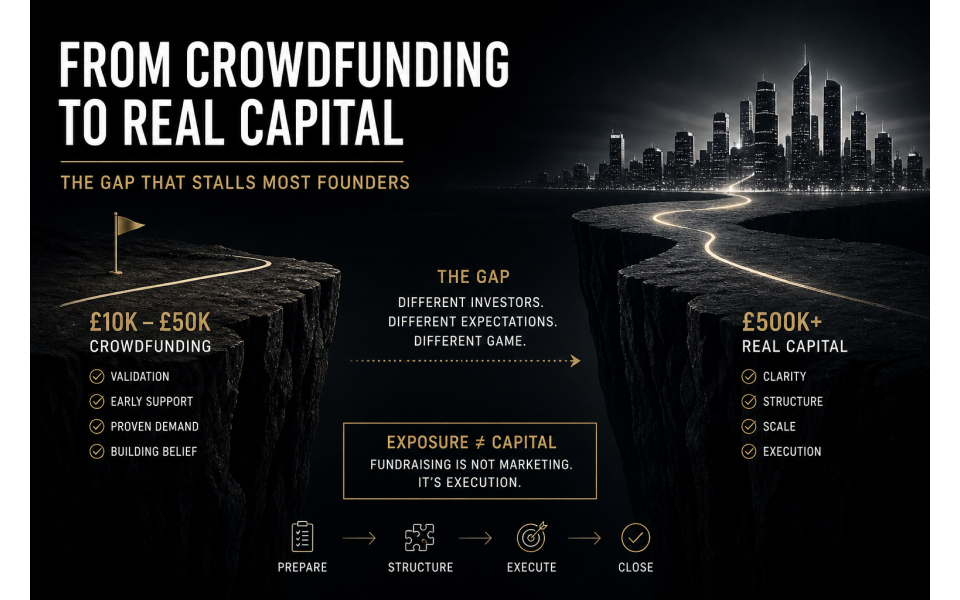
From crowdfunding to real capital
May 2026
Why most founders get stuck after their first raise
Most founders think fundraising is a campaign.
It is not.
It is a process.
And this is where most raises break.
Crowdfunding is validation, not a funding strategy
If you have raised £10k to £50k through crowdfunding, you have done something important.
You have proven that people care.
You have demonstrated early demand.
You may even have built a small community around what you are doing.
That is valuable.
But it is not the same as raising capital.
Crowdfunding tells you there is interest.
It does not solve for scale, hiring, or growth.
Those are different problems.
They require different capital.
And this is where most founders get stuck.
The most dangerous stage in fundraising
There is a gap that almost no one talks about.
The jump from £50k to £500k+.
On paper, it looks like a continuation.
In reality, it is a completely different game.
At £10k to £50k:
You are selling a story
You are building belief
You are leveraging community
At £500k+:
You are selling an outcome
You are being assessed on structure
You are expected to execute
Different investors.
Different expectations.
Different rules.
Most founders do not adjust.
You are not early anymore
Once you have proven demand, you move into a new category.
You are no longer “early”.
You are in the next stage.
And with that comes scrutiny.
Investors start to ask different questions:
Can this scale?
Is the structure investable?
Is there a clear path to returns?
Is this a serious opportunity, or just an interesting idea?
This is where many promising raises stall.
Not because the idea is bad.
But because the approach has not evolved.
Exposure does not equal capital
One of the biggest misconceptions I see is this:
“If we get more visibility, the capital will follow.”
It rarely works that way.
You can have:
A great campaign
Strong engagement
Good PR
And still not raise the capital you need.
Because fundraising is not marketing.
It is execution.
Investors do not fund campaigns
They fund outcomes.
That is the shift.
Early on, people back you because they believe in what you are building.
Later, investors back you because they believe in what this becomes.
That requires:
clarity
structure
credibility
Without those, momentum fades quickly.
The founders who break through do one thing differently
They stop treating fundraising like an event.
They treat it as a process.
A repeatable, structured process.
In simple terms:
Prepare → Structure → Execute → Close
Preparation means getting your story, materials, and positioning right.
Structure means aligning your raise with the right type of capital.
Execution means targeted outreach and disciplined follow-up.
Closing means managing the process all the way through.
Most founders skip at least one of these steps.
That is usually where things break.
Turning traction into structured capital
The hard part is not raising your first money.
It is what comes after.
Turning early traction into structured capital is where deals either get done, or fall apart.
This is the moment where:
the narrative needs to mature
the investor base needs to shift
the process needs to tighten
If you treat it like a continuation of your first raise, you will struggle.
If you treat it like a new phase entirely, you have a much better chance.
Final thought
Fundraising is not about visibility.
It is about execution.
That is the difference between raising something… and raising properly.
Oliver
If you are in that £50k to £500k+ gap, this is exactly the stage where things either accelerate or stall.
Happy to share thoughts if useful.
Stay up to date
Get our occasional newsletter featuring fundraising news, hints and tips, and our favourite projects