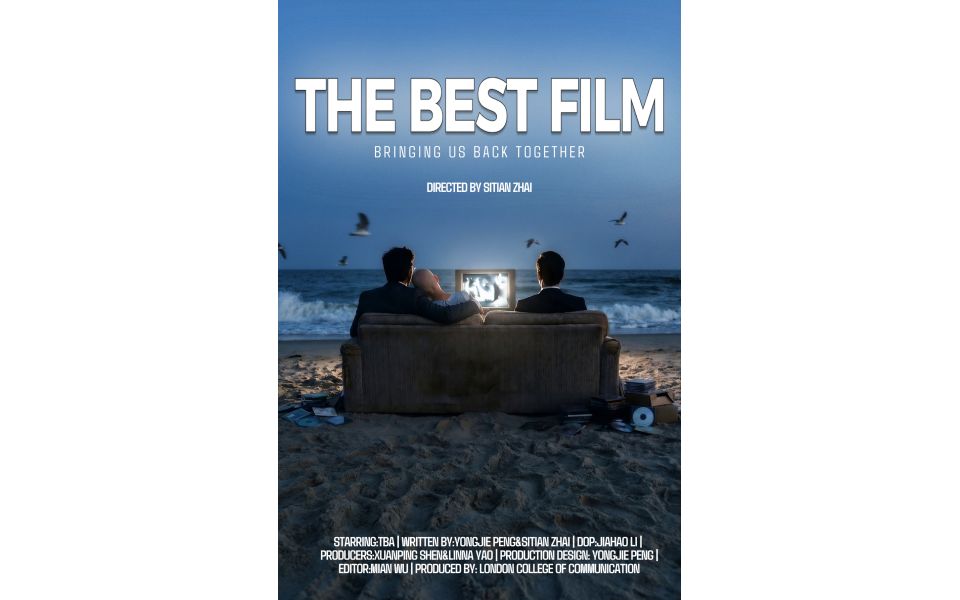
时长15-20分钟的原创短片,UAL电影硕士毕业作品。使用ARRI电影设备和专业器材拍摄。故事和制作均为100%原创。
影片将在伦敦艺术大学放映,并提交至国际及中国电影节,同时将在YouTube、Bilibili等平台发布。该片由一支主要由中国学生组成的团队在英国拍摄完成。
导演声明
表面上看, 《最佳影片》 像是一部心理惊悚片、一部荒诞的家庭剧,以及一段穿越记忆与电影的超现实之旅。但对我而言,它的核心并非一部关于电影制作的电影。它讲述的是被误解扭曲的爱,是隐藏在讽刺和疏离背后的悲伤,也是在为时已晚之后才看清家人的痛苦过程。
这个故事最吸引我的地方在于它拒绝简单的道德框架。这里没有明确的反派。本、彼得和他们的母亲并非被残酷所困,而是被沟通失败和代代相传的情感习惯所束缚。母亲反复问道:“你拍出最好的电影了吗?” 这句话起初听起来像是一种挥之不去的命令,近乎诅咒。它听起来控制欲强、咄咄逼人,而且永远无法满足。但随着故事的展开,这句话的含义逐渐发生了变化。它不仅是一种压力,更是一种笨拙的爱、恐惧和失望的表达,而这种表达既指向她自己,也指向她的儿子。
这种转变是这部电影的情感核心。我感兴趣的是,家庭成员之间常常并非出于恶意,而是因为误解而互相伤害。我们听到的批评并非恐惧,控制并非渴望,沉默并非爱。本将母亲的期望解读为评判。他视母亲为羞耻、艺术创作停滞和无法前进的根源。但在愤怒之下,隐藏着更为脆弱的东西:内疚、悲伤,以及一种迫切想要摆脱这段在他母亲生前从未真正理解的关系的渴望。
Peter, in contrast, represents another way of dealing with loss. If Ben escapes, Peter stays. If Ben turns pain into irony and distance, Peter turns it into duty and endurance. Their conflict is not simply about personality or values; it is about two different survival strategies within the same family. One brother protects himself by leaving, the other by carrying the weight. Neither is fully right, and neither is free. That complexity is important to me. I do not want this story to become a simple confrontation between the “wounded son” and the “difficult mother.” I want it to remain a story in which everyone is limited, everyone is lonely, and everyone is trying — unsuccessfully — to love.
Formally, I see The Best Film as a fluid experience in which reality, memory, hallucination, and cinematic language constantly bleed into one another. Ben is not simply revisiting the past; he is being overtaken by it. The hospital corridor, the mother in a gown, the repeated appearances of Peter in different film-inspired forms, the strange shifts in tone — these are not merely stylized devices. They are expressions of Ben’s inner state. His grief does not arrive in a realistic, orderly way. It arrives through fragments, repetitions, distortions, and performance.
That idea of performance is central to the film. Within families, we often stop speaking honestly and begin performing fixed roles for one another: the demanding mother, the rebellious son, the dependable brother. In this story, cinema becomes both a shared language and a mask. These characters connect through films, references, and borrowed identities, but they also hide behind them. Peter’s shifting personas are not just playful intertextual gestures; they reflect a family that has learned to communicate through cinema more easily than through direct emotion. Film, in this world, is both intimacy and avoidance. It is what binds them together, and what keeps them from saying what they actually mean.
Visually, I want the film to move between two distinct textures. The first half should feel cold, tense, and fractured. I imagine hard light, blue-gray tones, empty interiors, and frames that isolate the characters within doorways, corridors, and screens. These spaces should feel psychologically hostile — not overtly supernatural, but emotionally unstable, as if memory itself were beginning to infect the present. The hospital imagery in particular should carry a recurring nightmare quality, something both intimate and terrifying.
As the film progresses, however, the visual language gradually softens. When Ben moves deeper into childhood memory and emotional recognition, warmth begins to enter the frame. The living room scenes, the rain, and especially the seaside sequence should feel more fluid, more open, and more tender. I am interested in an image world that hovers between realism and dream — not fully naturalistic, not fully fantastical. The sea at the end is especially important to me. It is not simply a symbolic place of closure, but a threshold where accusation, memory, and longing can finally give way to release.
The ending is the key to the entire film. What moves me most is that it does not rely on a dramatic confession or a clean reconciliation. Instead, it arrives at something quieter and more profound. When the mother says, “I want to make my own film,” the emotional direction of the story changes completely. She is no longer defined only as a mother, or as the source of Ben’s pain. She re-emerges as a person — someone who once had her own desires, her own artistic impulse, her own life interrupted by family roles and circumstance. This moment matters deeply to me because it frees both of them. She stops living through her son, and he is finally allowed to create not for her approval, but for himself.
In that sense, The Best Film is also about reclaiming subjectivity. It asks what happens when we stop seeing our parents as symbols — of sacrifice, pressure, trauma, or expectation — and begin seeing them as unfinished human beings. That recognition does not erase the hurt. It does not excuse the damage. But it makes a more complicated form of forgiveness possible: not forgiveness as absolution, but as understanding.
In working with actors, I would want to avoid broad emotional coding. Ben should not be played simply as cold or angry; he is sharp, wounded, self-conscious, and deeply vulnerable. Peter should not be reduced to the “good brother”; his patience is inseparable from exhaustion and resentment. And the mother must never become a one-dimensional figure of oppression or martyrdom. She is funny, intrusive, disappointed, loving, and tragic at once. The film only works if all three characters remain fully human in their contradictions.
Ultimately, The Best Film is not interested in answering what the “best film” is. It is interested in something far more difficult: how to live with regret, how to survive love that was imperfectly given, and how to begin again after loss. If this film has a destination, it is not triumph but release. Not a final explanation, but a gentler way of carrying what cannot be undone.
To me, this is a film about a delayed goodbye. But even more than that, it is a film about what becomes possible after the goodbye finally happens.
Story Synopsis
Ben has spent years haunted by a single question: “Have you made the best film yet?”
The question comes from his mother, and it has followed him like a curse.
After their mother’s death, Ben returns at the invitation of his younger brother, Peter. The two brothers sit together in front of a television, watching a film in a room that feels both familiar and emotionally distant. Ben, as always, hides behind irony and indifference. He mocks Peter’s choice of film, behaves carelessly, and uses sarcasm to disrupt the fragile atmosphere. Peter, in contrast, struggles to remain composed, attempting to preserve a sense of order and dignity. What begins as a disagreement over cinema quickly develops into a deeper confrontation about their mother, their family, and the unresolved wounds of the past. When Peter mentions Ben’s childhood ambition to one day “make the best film,” Ben immediately identifies the phrase as the burden their mother placed on him for years. In his memory, she did not encourage him but criticized him, doubted him, and even tore up his writing, leaving him with the conviction that he was never truly understood or affirmed. Peter rejects this interpretation, insisting that Ben never really understood their mother and has refused to face her complexity.
The argument intensifies until Peter throws Ben out of the apartment. Even then, Ben refuses vulnerability and continues to mock Peter, dismissing him as someone trapped in fantasy and performance. Peter finally forces the central issue into the open: where was Ben when their mother was seriously ill, and where was he when she died? Why was Peter left to bear the burden of care, hospital visits, paperwork, and grief alone? Ben responds defensively, saying that he did return once, but when he saw their mother near the end of her life, she still asked him the same question — whether he had made the best film yet. To Ben, this proves that even in her final moments she was not concerned with him as a son, but only with the ambition she had projected onto him.
After leaving Peter’s home, Ben intends to do what he has always done: walk away. Yet reality begins to shift in increasingly disturbing ways. At bus stops, on the street, and inside cafés, he repeatedly encounters different versions of Peter. One appears dressed like a black-clad action hero in dark glasses; another seems to imitate a character from a classic film; others are so exaggerated that they border on parody. At first Ben assumes this is simply another one of Peter’s strange performances. Soon, however, it becomes clear that he is no longer moving through ordinary reality. He has entered a surreal space in which memory, cinema, and psychological projection begin to overlap. Everything he has tried to suppress now returns to confront him in strange and cinematic forms.
This breakdown reaches its peak inside a café. Ben sees multiple versions of Peter seated around the room like characters drawn from different films. Then, abruptly, an absurd robbery scene unfolds. The gunman is once again Peter, and beside him stands a short-haired woman who is unmistakably their mother. She raises the gun toward Ben and asks him once more: “Have you made the best film yet, Ben?” Terrified, Ben runs. He finds himself in a dark corridor resembling a hospital hallway. At the end of it, his mother approaches him in a white hospital gown, wearing a broken oxygen mask, bleeding from the nose, and losing her hair. She appears as a horrifying condensation of Ben’s memories of illness, decay, and death. Overwhelmed by fear and rage, Ben screams at her to leave him alone. He refuses to remain trapped inside her expectations and the burden of her unfinished desires.
At the height of this psychological collapse, Peter appears once more, now less as an antagonist than as a guide. He leads Ben back into the house of their childhood. Outside, it is raining. Inside, the living room glows with warmth. Young Ben, child Peter, and their mother are sitting together under a blanket, watching Pulp Fiction. For the first time, Ben is able to revisit a memory not through resentment, but through observation. He notices that his mother’s way of engaging with film was often teasing, contradictory, and performative. She would joke, provoke, and criticize, even when she was fully involved. Ben also realizes that many of his own sarcastic gestures in the present unconsciously resemble hers. What he once interpreted only as hostility now begins to appear more ambiguous.
As the memory unfolds further, young Ben passionately analyzes the film with confidence and seriousness. Their mother responds by teasing him and insisting that if he truly loves cinema, he should one day make something better — the best film. Young Ben hears this as dismissal. Hurt and offended, he leaves believing that his mother neither understands him nor respects his vision. Yet after he exits, child Peter hears their mother express a very different truth. She admits that she actually admires Ben’s talent and intensity and has always been proud of him. Her problem is not a lack of faith, but an inability to express love directly. She believes he is too self-assured and must be challenged in order to grow. What she intended as motivation, he experienced as negation.
Hearing this as an adult for the first time, Ben begins to understand that the story he has told himself for years may have been built on a profound misreading. Peter then confronts him with an even more painful truth. Ben has not cast himself as a victim because his mother never loved him; he has done so because he cannot bear the guilt of having been absent when she needed him most. By turning guilt into resentment, he has made it possible to survive emotionally. His anger has functioned as a defense against shame, grief, and longing. This insight breaks through the structure of self-protection that has sustained him for years.
Ben finally admits that he did care, and that his distance was not indifference but fear — fear of loss, fear of responsibility, and fear of facing what his absence means. Peter also allows his own pain to surface. He confesses that being the one who stayed has left him exhausted, resentful, and unseen. In this shared vulnerability, the brothers begin to reconcile. They recognize that cinema, which should have connected them, has instead become the medium through which they avoided direct feeling. Film has served as a common language, but also as a mask.
Guided by Peter, the brothers eventually pass through another threshold and arrive at a beach at dusk. The sea is calm, the light blue and fading. On the sand sits a sofa, a television set, and a scattering of DVDs, as though the memory of their family living room has been relocated to the shore. Their mother is seated there with her back to them. Ben and Peter approach and sit beside her, as they once did in childhood.
In this final encounter, their mother speaks not only as a mother but as an individual. She admits that her repeated insistence that Ben make “the best film” came from her own unfulfilled life. She had projected her unfinished desires, lost ambitions, and unresolved need for meaning onto her son’s dream. She feared that if she stopped pushing him, she would lose him; she also feared that if he never achieved something extraordinary, her own life would remain incomplete. But she now recognizes that this burden was unfair to him and imprisoning for herself.
She tells Ben that he should make the films he truly wants to make — not for her, and not in order to prove anything. She tells Peter that he no longer needs to remain the guardian of the family. Then she says the sentence that redefines the entire story: “I want to make my own film.” By this she does not mean literally becoming a filmmaker. She means reclaiming a life that belongs to her alone: dancing, cooking, painting the walls the color she likes, going to the cinema by herself, and learning how to live as someone other than a mother. For the first time, she allows herself to exist as a person with her own desires and identity.
直到那时,本才彻底明白自己一直在等待的是什么。他需要的并非简单的认可;他需要的是母亲从她一手将他们困住的角色中解脱出来。当她不再下达“拍出最好的电影”的命令时,他也从内疚、怨恨和情感麻木中解脱出来。看着她沿着海岸轻盈地、几乎像在跳舞般地走远,本感受到了一种从未体验过的平静。站在他身旁的彼得也分享了这份解脱。兄弟俩第一次能够相信,他们的母亲不再受苦——而他们自己或许也能开始疗愈。
几个月后,他们的母亲搬进了新家。墙壁被漆成了温暖的橙色。桌子上放着一台老式相机。她做饭、拍照,然后把新生活的照片发给本和彼得,仿佛她终于开始了属于自己的生活。
《最佳影片》的核心 是一个关于悲伤、误认和情感传承的故事。它通过一段由记忆和电影构建的超现实旅程,探讨了家庭成员如何将自己未竟的人生投射到彼此身上,爱如何被误解为伤害,以及只有当每个人最终被完整地看待时,和解才有可能实现。